
SmallSat Europe 2027 / Technical Program
Technical Program
Research, engineering and operations across platforms, payloads and missions, selected by the technical committee and presented on the Technical Stage. Abstracts are due 29 January 2027.
Call for papers How to submit Proceedings archive ↗ Speak on a track
Call for papers · Open now
Present your research on the Technical Program.
01
Submit an abstract
Platforms, payloads, propulsion, GNC, ground segment, operations and flight results. Abstracts are due 29 January 2027.
02
Technical committee review
The technical committee reviews every abstract. Decisions go out on 5 March 2027.
03
Present in Amsterdam
Accepted papers are presented 1–3 June 2027: on the Technical Stage, at your own kiosk, or by invitation on the main stage. There is no fee to present and presenters get 50% off registration.
04
Proceedings
Full papers are optional (due 30 April 2027) and published with a permanent DOI in the 2027 proceedings. Past years are in the proceedings archive.
Paper submission
What to prepare, and what happens next.
Your abstract
150–300 words, cleared for public release
State the goal of the work, the methods used and the results or expected outcomes, with the title as it should appear in the programme. Pick a category (Missions, Research, Engineering or Technology) and a focus area, add presenter and author details, and say whether you plan a full paper. Abstracts that read as marketing are not accepted.
Selection
Reviewed by the technical committee
Originality, technical depth, relevance to the audience and the absence of a promotional focus. Flight results and lessons learned get priority in every focus area. Decisions go out on 5 March 2027.
Presenting
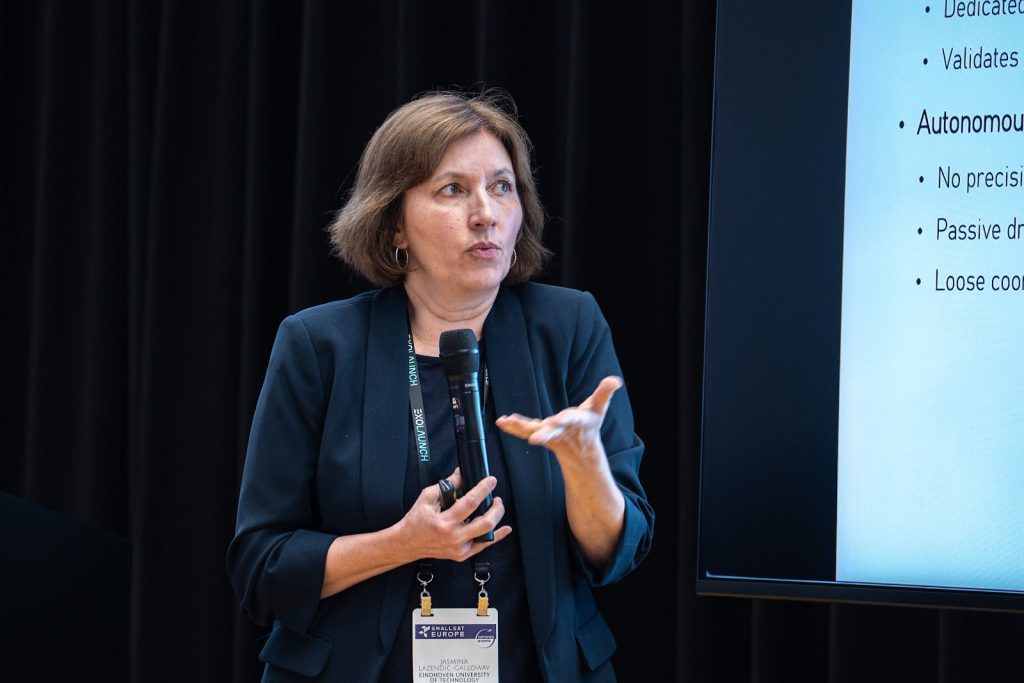
Three ways papers are presented
- Kiosk: every accepted paper gets a 30-minute session on a 55-inch 4K touchscreen.
- Technical Stage: selected papers give a 15-minute talk, then take questions at their kiosk.
- Main stage: four or five standout papers, by invitation of the technical committee.
Focus areas
Flight results and lessons learned get priority
- Secure Connectivity & Navigation IRIS² and GOVSATCOM, LEO-PNT and early Celeste results, optical links, multi-orbit networks, direct-to-device, quantum key distribution, digital payloads.
- Earth Observation & ISR SAR, optical and hyperspectral sensing, RF geolocation, responsive tasking, onboard processing, data fusion and EOGS readiness, maritime and climate monitoring.
- Defence, Security & Contested Orbit Space domain awareness, manoeuvrability and VLEO, hardening and anti-jamming, cybersecurity, dual-use design, allied constellations.
- Platforms, Production & Launch Bus design for serial production, subsystems, AIT and qualification at volume, the European supply chain, new European launchers, rideshare and deployment.
- Autonomy, Software & Operations Onboard AI and edge computing, autonomous constellation operations, ground automation and ground-station-as-a-service, collision avoidance, digital twins and MBSE, first-year lessons in orbit.
- Sustainability, Servicing & Regulation Debris mitigation and end-of-life design, active debris removal and servicing, rendezvous and capture, EU Space Act compliance, space traffic management, spectrum and licensing.
- Science, Exploration & University Missions Space and Earth science payloads, astronomy and heliophysics, lunar and deep-space smallsats, in-orbit research and demonstration platforms, student-built and university missions.
Key dates
| Milestone | Date |
|---|---|
| Abstracts due | 29 January 2027 |
| Decisions | 5 March 2027 |
| Presenter registration | 22 March 2027 |
| Full paper (optional) | 30 April 2027 |
| Slides | 14 May 2027 |
| SmallSat Europe 2027 | 1–3 June 2027 |
Presenting is free
Fees, awards and proceedings
There is no fee to present.
- Students who are first author and presenter attend free.
- Presenters get 50% off registration with the code in their acceptance email.
- Every accepted paper gets a 20% code to share with colleagues.
- Full papers are optional: IEEE conference format, about six pages and no more than ten, as a PDF.
- Papers received by 30 April 2027 are eligible for the Best Paper awards in Missions, Research, Engineering and Technology.
- Published papers get a permanent DOI in the 2027 proceedings.